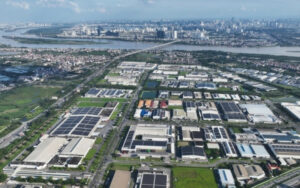
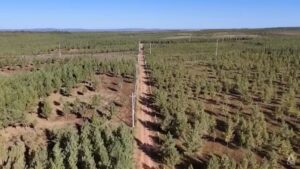
To strengthen the development of the renewable energy sector and create a complete value chain, the Ministry of Industry and Trade has officially proposed the construction of two inter-regional renewable energy industrial and service centers in the North and South. This represents one of the important strategic directions outlined in the Decision approving the Implementation Plan for the adjusted National Power Development Plan VIII that was recently issued.
Development orientation for two renewable energy centers
According to the proposed plan, the two inter-regional renewable energy centers will be strategically distributed to optimize the potential and advantages of each region.
The northern center is expected to be located in provinces and cities with favorable conditions such as Hai Phong, Quang Ninh, and Thai Binh. This region was selected due to its developed seaport system and strategic geographical location. At the same time, the possibility of expanding to adjacent areas in the future has also been carefully calculated to ensure the project's sustainability.
The southern center will harness the superior potential for wind and solar power in Ninh Thuan, Binh Thuan, Ba Ria - Vung Tau, and Ho Chi Minh City. These localities not only have abundant renewable energy resources but also possess modern port infrastructure, facilitating equipment transportation and product export.
Organizational structure and center components
Each inter-regional renewable energy center will be designed as a complete ecosystem with various functional components.
The core components include manufacturing plants for wind and solar power equipment, from small components to large-capacity wind turbines. These facilities will meet equipment needs for domestic projects and target exports in the future.
Additionally, professional logistics services will comprehensively support construction, operation, and maintenance activities for renewable energy projects. This includes developing specialized seaports with modern equipment, dedicated to serving the renewable energy sector.
The centers will also host green industrial zones with low carbon emission criteria, contributing to the nation's sustainable development goals. These industrial zones will apply environmentally friendly production technologies and use renewable energy in their manufacturing operations.
To ensure high-quality human resources, research and training institutions specializing in clean energy will be established at each center. These universities, research institutes, and training centers will provide highly qualified personnel to meet the sector's development needs.
Renewable energy development targets until 2030
According to the adjusted National Power Development Plan VIII, Vietnam has set ambitious targets for renewable energy development in the coming period.
By 2030, the total solar power capacity nationwide is expected to reach approximately 46,459 - 73,416 MW, showing strong growth in this energy type. Onshore wind power is also expected to develop significantly with capacity ranging from 26,066 to 38,029 MW.
Particularly, offshore wind power - a field assessed to have great potential - is targeted to reach 6,000 MW by 2030. This figure will continue to increase to 17,032 MW by 2035, demonstrating Vietnam's determination to exploit marine energy resources.

Application and energy export orientation
Vietnam's renewable energy development vision extends beyond meeting domestic demand to exports and production of new energy types.
In this plan, approximately 15,000 MW of capacity, mainly from offshore wind power, will be used to produce green hydrogen and green ammonia. These are high-value products that the world is interested in following the green energy transition trend.
Besides producing new energy products, Vietnam also aims to directly export electricity to regional countries. By 2035, the capacity for selling electricity to Singapore, Malaysia, and other partners could reach 5,000-10,000 MW.
This export level will be maintained at a minimum scale of 10,000 MW until 2050, with potential for higher expansion depending on actual demand from purchasing countries. However, all export activities must ensure principles of economic efficiency, energy security, and national defense for Vietnam.
The establishment of two inter-regional renewable energy centers not only demonstrates the government's determination to develop clean energy but also creates a solid foundation for sustainable economic development. With advantages in natural resources and geographical location, Vietnam can completely become an important renewable energy center in the region in the near future.
> See more: Vietnam Accelerates Green Energy Transition, Maintains Offshore Wind Power Development Targets
Cre: VNExpress