On May 14–15, 2026,the recent meeting between President Donald J. Trump and President Xi Jinping in Beijing once again placed U.S. - China relations at the center of global attention. Beyond diplomacy, the summit focused on several key issues:
- Trade and economic competition between the world’s two largest economies.
- Supply chains, particularly in semiconductors and strategic minerals.
- AI, manufacturing technology, and geopolitical stability amid intensifying U.S. - China rivalry.
The two sides signed several preliminary trade agreements: China committed to purchasing 200 Boeing aircraft, importing at least USD 17 billion worth of U.S. agricultural products annually, increasing crude oil imports, and easing restrictions on rare earth exports. Two bilateral trade and investment councils were also established.
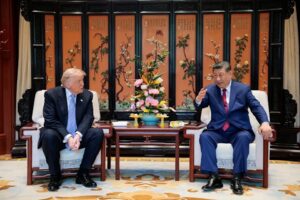
According to CSIS, the primary objective of this meeting was merely to “establish a minimum level of stability to avoid escalation,” rather than achieve meaningful reconciliation, because:
- Reciprocal tariffs remain in place.
- Competition in chips and AI continues.
- The Taiwan issue remains unresolved.
- Purchase commitments are not legally binding.
As tensions between the U.S. and China ease, global trade is expected to recover, driving higher manufacturing demand. Vietnam, as one of Southeast Asia’s leading export manufacturing hubs, stands to benefit directly from this shift.
Bên cạnh đó, In addition, Vietnam is emerging as a “bright spot” in the region by meeting many of the critical requirements of international corporations: a stable political environment, improving governance, expanding infrastructure, and a strategic location within Asia’s supply chain network. As a result, Vietnam has become an attractive destination for foreign-invested enterprises seeking to expand and establish manufacturing operations.
Looking ahead, President Xi Jinping’s anticipated visit to the White House in September 2026 could pave the way for additional cooperation agreements and investment shifts across the region. In this context, could now be the right time for businesses to establish an early presence in Vietnam before the industrial park and factory market enters another wave of rising demand?
Nguồn: Tổng hợp