The Standing Committee of the Government has issued a conclusion notice regarding the Adjustment of Power Plan VIII, emphasizing the need to maintain the schedule for gas power and offshore wind projects. The committee has rejected the Ministry of Industry and Trade's proposal to delay implementation of these projects beyond 2030.
Firm Commitment to Diversified Power Source Development
According to the previously approved Power Plan VIII, offshore wind power capacity was expected to reach approximately 6,000 MW by 2030. However, to date, no projects have been approved or assigned for investment. In the recent draft adjustment to Power Plan VIII, the Ministry of Industry and Trade proposed postponing the development of this power source until after 2030, with a target of reaching around 17,000 MW by 2035.
The proposed adjustment also included rescheduling several delayed LNG gas power projects to the post-2030 period. Consequently, the total capacity of LNG gas power sources for the next five years would be reduced to 8,824 MW, a significant decrease of approximately 13,576 MW compared to the original target in Power Plan VIII.
In response to this proposal, the Standing Committee of the Government has issued clear directives: rejecting the schedule adjustments and requiring that gas power and offshore wind power projects be completed before 2030 as initially planned.
Ensuring a Sustainable and Efficient Power Structure
The Standing Committee has tasked the Ministry of Industry and Trade with developing plans for diverse power sources, emphasizing that baseload power must account for over 50% of the total structure. Notably, the guidance includes increasing the proportion of LNG power sources while correspondingly reducing coal power, aiming to ensure sustainable and environmentally friendly development goals.
The Ministry of Industry and Trade has been instructed to actively work with investors, particularly foreign investors, to find solutions for project challenges, preventing delays and resource waste. The Government also noted the need to definitively resolve issues related to gas power development policies, especially regarding the transfer of fuel prices to electricity prices and long-term minimum contract power output (Qc).
The Vast Potential of Offshore Wind Power
According to the World Bank (WB) assessment, Vietnam has offshore wind power potential of approximately 600 GW. This energy source is projected to contribute up to 12% of the country's total electricity production by 2035, highlighting its important role in Vietnam's future energy development strategy.
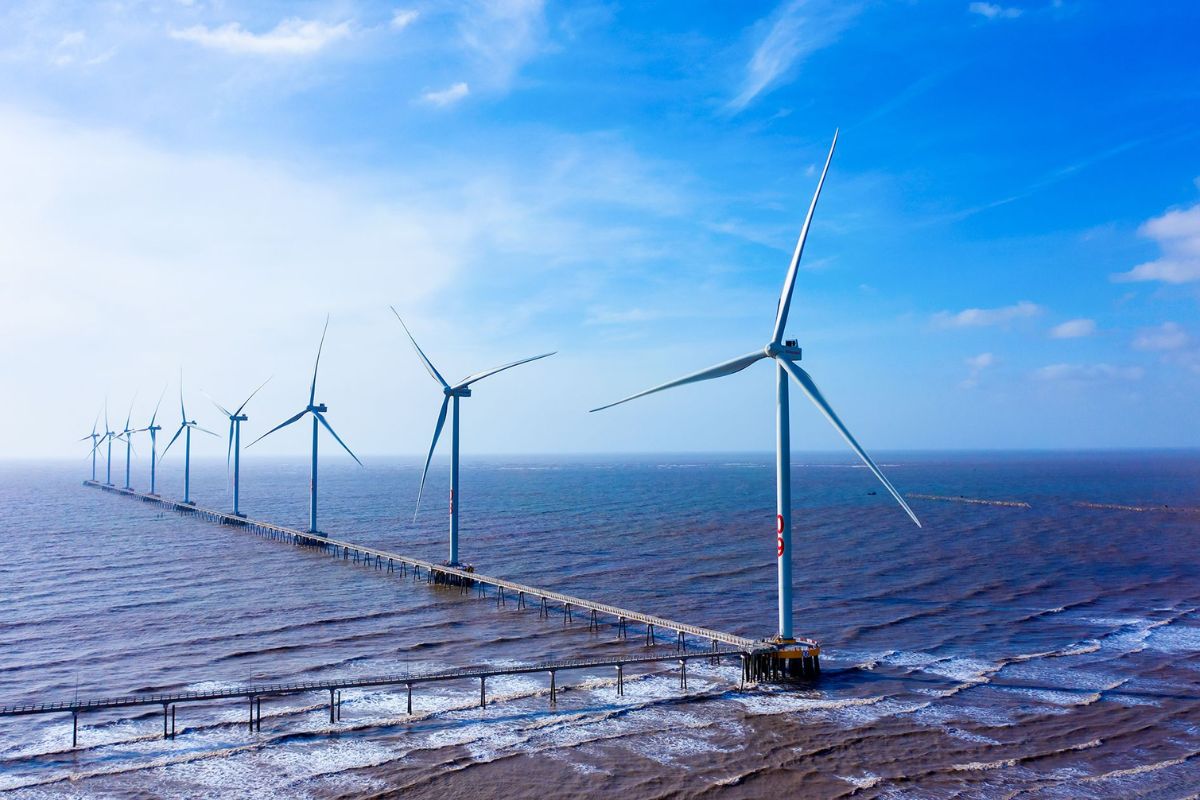
Offshore wind power – A clean and sustainable energy source
Recently, many foreign investors have expressed interest in developing offshore wind power projects in Vietnam. Pacifico Energy (PE) Group has recently committed to investing several billion USD in this sector during a meeting with Prime Minister Pham Minh Chinh. Similarly, Sembcorp Group (Singapore) has proposed developing training programs and cooperation in offshore wind power, while CIP Group (Germany) has signed a cooperation agreement with Vietnam Energy Industry Group (PVN) to research and develop offshore wind power projects.
More than two years ago, 36 domestic investors applied for offshore wind power surveys, but at that time, the Ministry of Natural Resources & Environment recommended suspending permits due to legal complications. This situation highlights the necessity of perfecting the legal framework to attract and promote investment in this sector.
Economic Development Goals and Electricity Demand
This year, the Government has set a GDP growth target of at least 8%, aiming for double-digit growth in the 2026-2030 period. To meet the electricity demand for this economic growth target, the Ministry of Industry and Trade has proposed that the total installed power capacity nationwide by 2030 (excluding cogeneration sources and risks) should reach 211,805 MW, an increase of more than 56,000 MW compared to Power Plan VIII approved nearly two years ago.
To achieve this capacity increase, the Ministry of Industry and Trade proposes expanding the development potential of renewable energy sources, increasing electricity imports, and developing flexible thermal power sources. Specifically, the plan includes increasing solar power capacity by 3.9 times (to over 34,000 MW), increasing pumped-storage hydropower and battery storage capacity by 6 times, while enhancing electricity imports from China and Laos.
Future Electricity Development Directions
The Standing Committee of the Government emphasizes that the Adjustment of Power Plan VIII should encourage the development of renewable energy sources, especially self-production and self-consumption power sources, and rooftop solar power. The mechanism also aims to encourage economic entities to participate in direct electricity trading mechanisms and considers the possibility of exporting electricity to ASEAN countries in the future.
Regarding power grid development, the Ministry of Industry and Trade is required to calculate plans appropriate for power source development, supplement coastal transmission grid systems, and plan for capacity evacuation from offshore wind power plants. Projects for transmission to export electricity to Singapore, Malaysia, and Cambodia also need to be studied and supplemented.
In particular, the adjusted Power Plan VIII needs to focus on large electricity consumption loads in the future, such as data centers, semiconductor chip production plants, and AI technology. Accordingly, the drafting agency needs to conduct thorough research and consideration to prepare sufficient power sources to meet the demands of these loads, ensuring no electricity shortage when high-tech industries develop.
Cre: VNExpress
>> See more: Vietnam's Energy Market Set for Major Transformation in 2026-2030